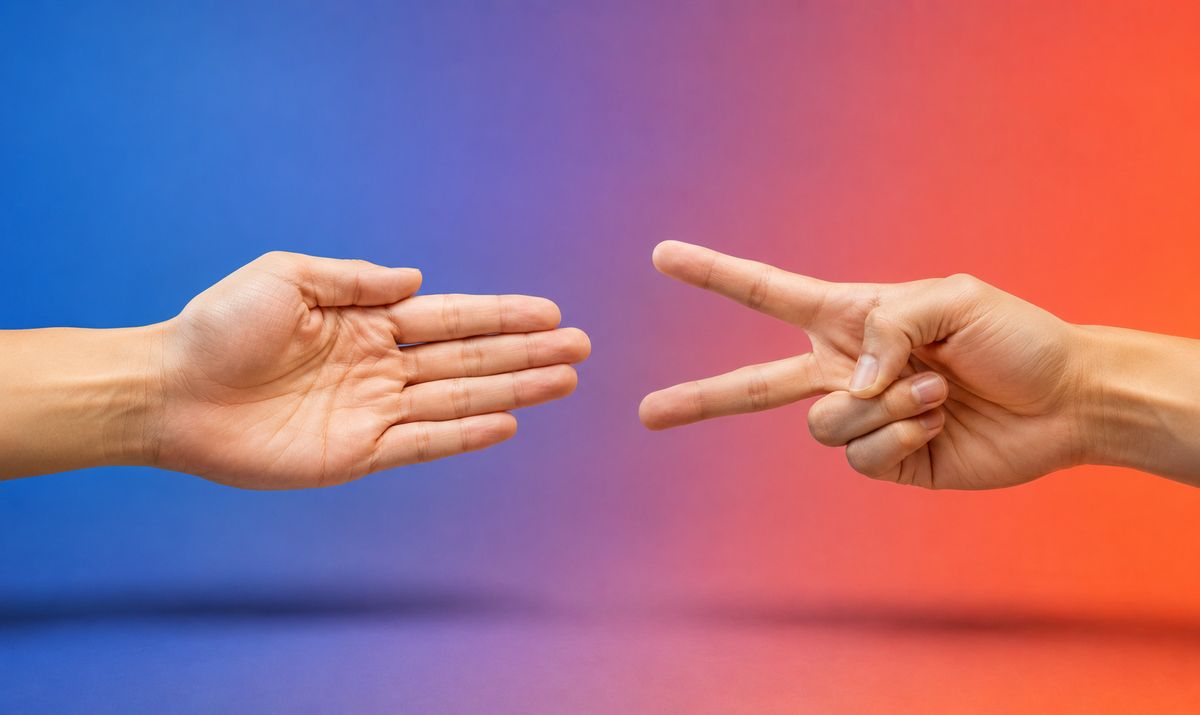
Is Rock Paper Scissors Luck or Skill?
The honest answer is: both, depending on who you are playing. If your opponent threw perfectly at random, nothing could give you an edge — you would win exactly one game in three, lose one in three, and tie one in three, forever. That is the math, and no trick changes it.
But people are terrible at being random. Our brains are pattern-making machines, and under the small pressure of a game we leak those patterns constantly. We repeat what just worked, we avoid what just failed, and we reach for certain hands more than others without realizing it. Skill in Rock Paper Scissors is the skill of reading those leaks — and avoiding your own. The World Rock Paper Scissors Association has run competitive tournaments on exactly this premise for years.
The First-Throw Bias: Why Rock Loses
The single most documented pattern in the game is the opening throw. Across surveys and tournament data, rock is thrown first far more often than one third of the time, especially by men and by inexperienced players. Rock feels strong. It feels aggressive. It is the fist you make when you are determined to win — and that emotional pull makes it predictable.
The practical takeaway is simple:
- Against a stranger, open with Paper. If they are statistically likely to throw rock, paper quietly beats it.
- Never open with rock yourself if your opponent knows this game. You are walking into the most predictable move there is.
- Experienced players over-correct away from rock — so against a known sharp, scissors can be a better opener, since they are avoiding rock and leaning paper.
Win-Stay, Lose-Shift: The Most Reliable Pattern
This is the pattern that wins more games than any other, and it comes straight from behavioral science. Most people, most of the time, follow a rule they have never consciously chosen:
The Win-Stay, Lose-Shift Rule
After winning, players tend to repeat the hand that just won.
After losing, players tend to switch to a different hand.
A landmark study of Rock Paper Scissors players published by researchers at Zhejiang University found exactly this behavior at scale: winners repeated, losers rotated. Once you know it, it becomes a weapon.
How to use it after your opponent wins
Say your opponent just beat you with rock. The win-stay tendency says they are likely to throw rock again. The hand that beats rock is paper — so paper is your high-percentage counter. You are not guessing; you are playing the odds their own psychology created.
How to use it after your opponent loses
If your opponent just lost with scissors, they will probably abandon scissors and shift. People who shift tend to move to the hand that would have beaten their last throw — so after a losing scissors, many players jump to rock. If you expect rock, you throw paper. Reading the shift is trickier than reading the repeat, but the direction of the shift is itself a pattern.
Want to practice reading patterns in real time? Play Rock Paper Scissors free and put the theory to work.
Play Rock Paper Scissors FreeGambits: Think in Threes, Not Ones
Competitive players rarely decide one throw at a time. The reason is subtle but important: when you decide hand by hand, you leak patterns under pressure. Deciding a sequence of three in advance — a "gambit" — keeps your play disciplined and harder to read. The World RPS community gave the common sequences names:
| Gambit | Sequence | Idea |
|---|---|---|
| The Avalanche | Rock · Rock · Rock | Pure aggression — unsettling because nobody expects three of the same. |
| The Bureaucrat | Paper · Paper · Paper | The quiet mirror of the Avalanche. |
| The Great Dynamite | Scissors · Paper · Rock | A full rotation that feels "balanced" to opponents. |
| The Crescendo | Paper · Scissors · Rock | Builds from weak-feeling to strong-feeling. |
| The Toolbox | Scissors · Scissors · Scissors | Rarely expected — most players never repeat scissors. |
Gambits do not magically beat a random opponent. Their value is defensive: they stop you from being the predictable one. The player who leaks fewer patterns wins the long match.
Level Thinking: The Real Game Behind the Game
Top Rock Paper Scissors comes down to a layered guessing match that game theorists call "level-k thinking." It is the same loop that drives poker bluffs and penalty-kick standoffs, and it stacks like this:
- Level 0 — throw whatever feels right. Most casual players live here.
- Level 1 — "They'll throw rock, so I'll throw paper." You are countering their likely move.
- Level 2 — "They expect me to throw paper, so they'll throw scissors — I'll throw rock." You are countering their counter.
- Level 3 — and so on, each layer anticipating the one below it.
The trick is not to climb as high as possible. It is to play exactly one level above your opponent. Go too deep against a Level 0 player and you out-think yourself into a loss; the move that beats raw instinct is the simple Level 1 counter. The skill is reading how sophisticated the person across from you is, then sitting one rung higher — no more.
Who Throws What: The Statistical Tells
Large surveys of Rock Paper Scissors throws reveal soft but real tendencies you can lean on when you know nothing else about an opponent:
- Men lean rock. Rock is thrown noticeably more by male players, especially when they feel competitive or want to look strong.
- Scissors is the rarest throw overall. Across the population, scissors comes out a few points below one third — so when you are unsure, betting against scissors is a small edge.
- Beginners avoid repeating. New players feel that throwing the same hand twice is "too obvious," so they under-repeat — which is exactly why a planned double (like the Avalanche's rock-rock) catches them off guard.
- Stress narrows choices. A player on a losing streak tightens up and falls back on their default hand. Spot their default early, and the comeback round is yours.
None of these is a guarantee — they are nudges of a few percentage points. But a few points, applied consistently across a long match, is the entire difference between a coin flip and an edge.
Mind Games: Talking, Telegraphing, and Tells
In face-to-face play, the game starts before the throw. A few proven edges:
- Announce your throw — then actually throw it. Saying "I'm going rock" makes opponents assume a bluff and switch away from paper, often into scissors. If you really throw rock, you win. Doing this twice is dangerous; once is gold.
- Watch the hand shape forming. Some players partly pre-form their hand on the final count. A loose, relaxed hand often becomes paper; a tight fist stays rock.
- Disrupt the rhythm. Players settle into the "rock-paper-scissors-shoot" cadence and plan to the beat. A small change of pace breaks their pre-planned throw.
Managing Your Own Tilt
Here is the uncomfortable truth: the easiest pattern to read in any match is usually your own. After a couple of losses, players "tilt" — they start chasing, switching hands emotionally, and reaching for whatever just beat them. That makes you the most predictable person at the table, exactly when you can least afford it.
Two habits keep your own patterns locked down:
- Pre-commit to a gambit when you feel rattled. Deciding three throws in advance removes emotion from the next few rounds and stops the tilt-driven leak.
- Reset your read after each loss. Losing does not mean your opponent "has your number" — it usually means variance. Treat every round as a fresh independent puzzle rather than evidence that you are losing the meta-game.
When the Opponent Is Truly Random
Everything above works against humans. But what about a computer that throws with a genuine random number generator? Here, the truth is liberating rather than discouraging: no read, gambit, or mind game changes your odds. Every throw is independent, and your win rate sits at one in three no matter what you do.
That is exactly how the AI house works in our free Rock Paper Scissors game — each hand is drawn cryptographically, with no memory and no pattern to exploit. So where does skill go? It moves to a different decision entirely: when to stop. In a version where wins build a multiplier, your edge is no longer out-guessing the opponent — it is knowing when to bank a streak instead of risking it. Pattern-reading wins against people; disciplined cash-out timing wins against a random machine.
Quick Summary: How to Win More
- Open with paper against strangers — rock is the most common first throw.
- After they win, expect a repeat — throw the hand that beats their last winning hand.
- After they lose, expect a shift — read the direction and counter it.
- Plan in threes with a gambit so you stop leaking your own patterns.
- Against a random AI, switch goals — focus on smart cash-out timing, not on out-guessing.
None of this guarantees a win on any single throw — nothing can. But over a long session against real people, these edges add up, and that is the difference between losing half your games and winning more than your share.
Frequently Asked Questions
Can you really win at Rock Paper Scissors, or is it pure luck?
Against a truly random opponent it is pure luck — one in three, every time. Against humans it is partly skill, because people fall into predictable patterns you can read and counter.
What is the most common first throw?
Rock, especially among men and beginners. That makes paper a slightly better-than-even opening move against a stranger.
What should I throw after my opponent wins?
Watch them, not yourself. Players often repeat a winning hand, so throw the hand that beats their last winning throw.